


Here, now, we are all within the environment that surrounds us.
This condition often remains hidden precisely because it is naturally given. It is not necessarily present to our consciousness, except when something interrupts our continuity with the environment — a situation of danger, for example — or when we simply choose to bring our attention to it.
Indeed, consciousness rarely thinks: “I am here, now, in this environment.”
Instead, it remains occupied with the countless activities of everyday life: from simply reading to taking care of our families.
And yet, despite this natural connection between ourselves and the world around us, saying “I am here, in this environment” contains, at its roots, an implicit separation between ourselves and what surrounds us.
We might almost imagine that the environment could exist independently of us, and that we, in the same way, could live in any environment, simply adapting to it, as if we were something autonomous from it.
But we are not “static organisms.” We are “human organisms” in a constant process of transformation, just as the environment around us is. Within this incessant transformation of matter, perhaps the concept of becoming is more appropriate.
“I become in this environment.”
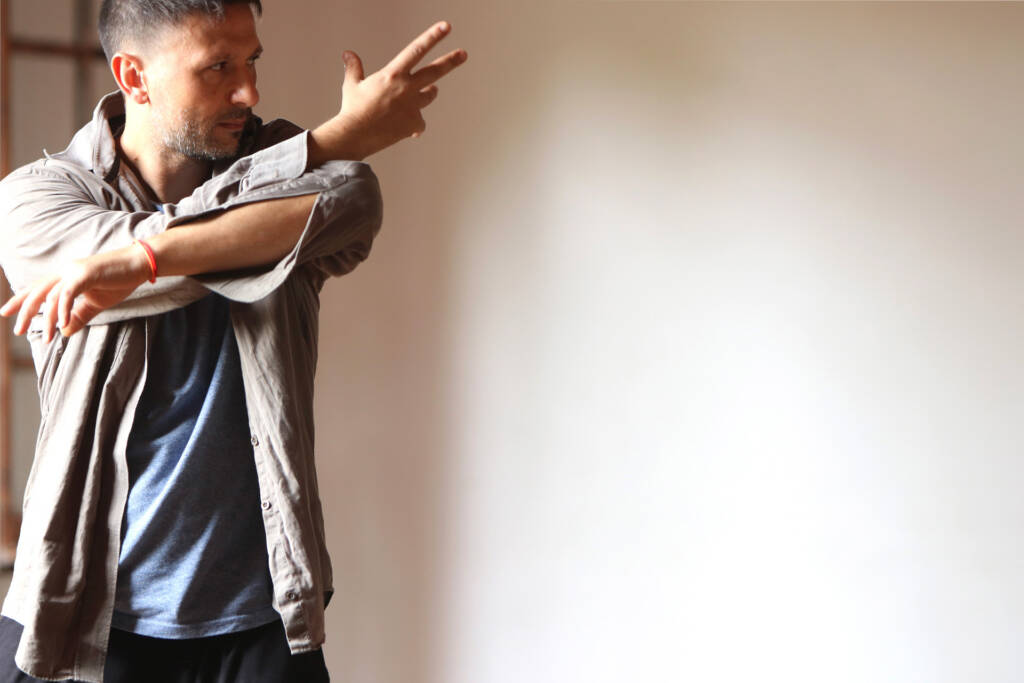
But here too, in some way, a dichotomous nature related to ‘being’ remains: I on one side, the environment on the other.
I would therefore propose another term:
“I manifest myself in this environment.”
Through the concept of manifestation, I can perceive my existence as interdependent with the environment. The environment is not simply the space in which something happens: it determines, at least to some extent, what I can manifest and how I can manifest it.
Manifestation is a dynamic that brings what is inside towards the outside and, in the same movement, places it in relation with what is outside. It is therefore not a one-way movement, but a process of mutual transformation: a form of coupling that produces an interconnected unity, the human-environment unity.
Manifestation depends as much on the inside as on the outside. It exists precisely as a relationship between these two aspects. The inside and the outside, therefore, are not two separate elements that subsequently enter into a relationship: the relationship itself is constitutive of manifestation.
I cannot understand what I am without considering the environment in which I manifest myself, just as I cannot understand the environment without considering the ways in which I participate in it.
In this sense, perhaps I am not simply in the world.
I am a manifestation of the world, in the world.
And among all the ways through which I realise myself — or learn — to manifest myself within the environment, one of the most profound for me is dance.
Dancing then becomes not only a way of expressing myself, but a way of investigating the very relationship between myself and the world: a way of perceiving how my dancing transforms the environment and, at the same time, how the environment transforms my dancing.